

In last week’s post, I published three model ETF portfolios, designed with the self-manager in mind. Following is an update on the “Ascend” portfolios, as well as a few comments on market conditions.
The "Ascend" Portfolios

For a while I have considered creating model portfolios that readers can track along with—in fact, 3 portfolios built with a specific rationale for each stage of a self-investor’s journey and designed for scale. I am pleased to provide the first versions of these portfolios below.
Each portfolio provides for a discrete level of experience:
Foundation: a simplified ETF portfolio creating the groundwork for future development.
Momentum: a ETF portfolio that builds confidence and range. It pushes boundaries and risk, while priming an investor for greater degrees of volatility.
Hyper-Frontier: a hyper-ambitious portfolio, that refines and expounds on learned risk-taking.
(Please be sure to read my disclaimers, if you haven’t already.) 1
Portfolio Performance
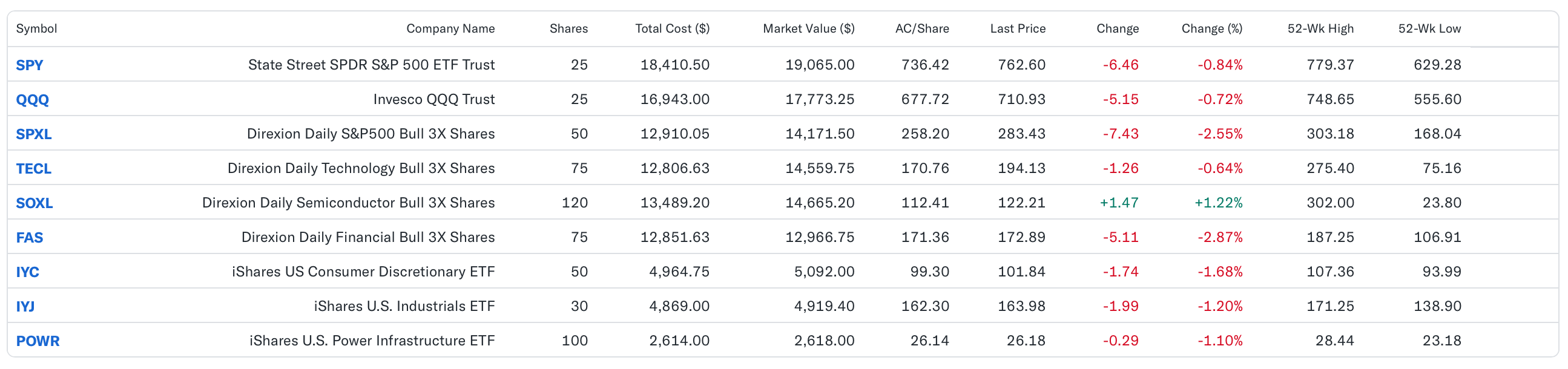
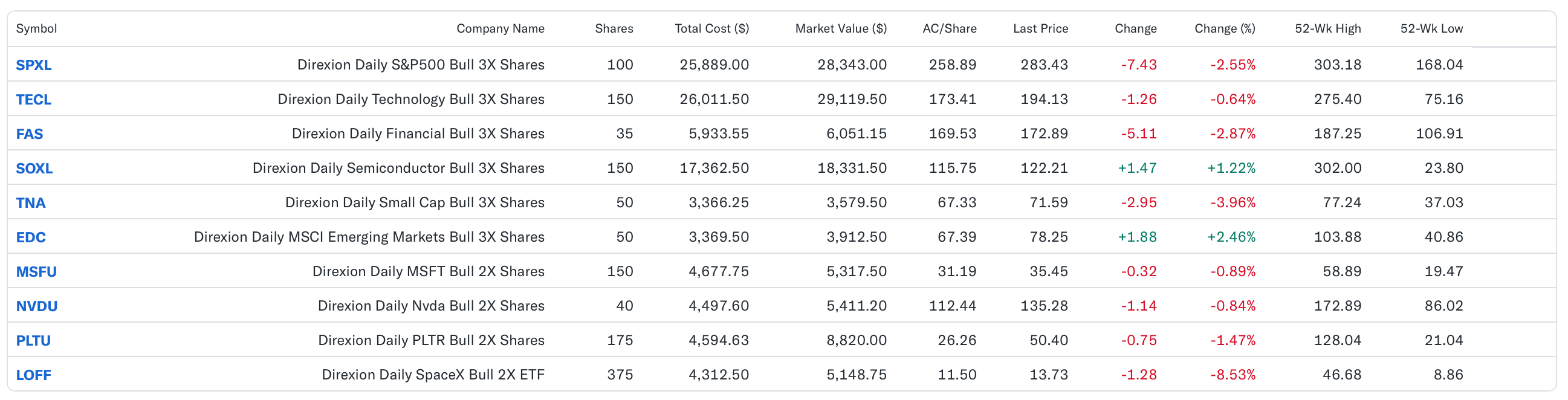
Following is an update on the portfolios during Week 3 (20 August, 2026).
The portfolios remain in a positive position since inception, despite a negative week in most major markets. The pullback was driven mostly by lack of progress in Iran, pressure on bond markets, and ongoing nervousness over inflation. However, I also believe that mid-term elections uncertainty is beginning to gain momentum, and weighs more than is appreciated.

👉 Not a subscriber? Access the portfolios for free by subscribing below!
Foundation

Momentum
Hyper-Frontier
ETFs in Focus
SPY 0.00%↑ and SPXL 0.00%↑ serve as core holdings in the portfolios for a very simple reason. These 500 companies not only include many of the growth companies (i.e., tech) driving the S&P 500, but also the beneficiaries of that technology.
In the coming years, AI-deployment outcomes will be of major significance to investors. While attention has remained largely on the ability of AI companies to justify their values (and addiction to spending), the implementation of AI within the world’s largest companies—the one’s who will leverage AI’s benefits—will matter more. It will matter more in terms of real-world application, revenue and profit margins.
The real AI story is not the most recent narrative, but how it is being used in real-world conditions. Watch this space.
Let Volatility Carry You Away

During times of market volatility, the temptation to avoid pain tends to grow. Believe it or not, volatility is when actual growth is achieved. Last week, one of our subscribers shared an article reminding investors how trying to time the market does more to ruin long-term gains than help. Missing only a handful of “up” days dramatically impacts returns over time.
Many, if not most, big days tend to come in the middle of volatile markets. So, reconsider before you jump out.
Bull markets grow on fear. That’s right! When investor sentiment is dour, upside surprises actually have the most impact. There are more reasons to remain vigilant, than there are to retreat and stay on the sidelines:
Economic sentiment has been less than positive for a while. That is positive for stocks. Why? Because earnings and forecasts continue to point towards economic growth. That surprise, in the face of lower sentiment, pushes stocks forward.
Iran is nothing new. (No cynicism intended.) What I mean is that, although outcomes aren’t clear yet, the geopolitical impact on markets is widely known. Meaning it is priced into stocks. Yes, there is, unfortunately, room for more surprises. But, on the whole, there is no new news, per se, which is actually good news relative to the market.
Bond yields are more likely pricing in the potential for slower economic growth and not recession. The yield curve remains steep.
Inflation remains tame albeit still above the Fed’s target. But expect sentiment to remain negative on inflation.
Lurking Uncertainty
The compilation of worries noted above (sentiment, Iran, bonds, inflation) feeds a negative narrative. And, as bull markets tend to “climb a wall of worry,” I remain bullish on stocks. In increasing levels of dourness, it is the unexpected surprise that will drive prices higher.
Markets hate uncertainty. Especially political uncertainty. One area of uncertainty that will persist for months is the upcoming Mid-Term Elections.
As primary election results trickle in, markets will react. Not necessarily to whether one party or the other is gaining an upper hand, but to the potential for one party gaining enough power to meaningfully shift policies. A shift in policy is normal. But, not knowing what that shift might look like rattles markets. The degree of parity—that is what markets are watching.
Have a great weekend!
This publication is for brains, not bets. The Other Side of Obvious shares ideas, stories, and general financial information—not personalized investment, tax, or legal advice. Investing comes with risk (including losing money). Talk to a pro before you act. Please take time to read these important disclosures before you get started.
I am a long-term investor focused on extended periods of performance (i.e., 10-20 years), using few, if any, short term bouts of trading. So, there won’t be a lot of movement in these portfolios.
This is not investment advice nor a recommendation to buy or sell certain investments. The intent of these portfolios is to illustrate the thinking behind the investments in the hopes that the reader might translate these ideas into his or her own portfolio in an appropriate and suitable way.
These model portfolios each contain levels of risk. In particular, the “Momentum” and “Hyper-Frontier” models contain leveraged products that are not suitable for all investors.
If you don’t have an investment goal, please start one. Here is a useful article on how to begin.
If you need help building your own portfolio, consider reading “How to Design a Model Portfolio.”