

For a while I have considered creating model portfolios that readers can track along with—in fact, 3 portfolios built with a specific rationale for each stage of a self-investor’s journey and designed for scale. I am pleased to provide the first versions of these portfolios below.

These three ETF-only portfolios range from a condensed version that allows for investing acclimation, to a development phase and finally, to an aggressive version intended only for advanced investors with money they can afford to lose. A range of portfolios, provided to offer a composite of ideas and products available to investors today.
First, please see important disclaimers, below:
I am a long-term investor focused on extended periods of performance (i.e., 10-20 years), using few, if any, short term bouts of trading. So, there won’t be a lot of movement in these portfolios.1
This is not investment advice nor a recommendation to buy or sell certain investments. The intent of these portfolios is to illustrate the thinking behind the investments in the hopes that the reader might translate these ideas into his or her own portfolio in an appropriate and suitable way.2
These model portfolios each contain levels of risk. In particular, the “Momentum” and “Hyper-Frontier” models contain leveraged products that are not suitable for all investors.
If you don’t have an investment goal, please start one. Here is a useful article on how to begin.
If you need help building your own portfolio, consider reading “How to Design a Model Portfolio.”
OK, now to the portfolios.
What’s In a Name?
The Ascend (move up, scale, conquer) portfolios were established on 30 July, 2026.3 I’ve called them Foundation, Momentum and Hyper-Frontier for specific reasons.
Foundation: a familiar portfolio that makes an investor comfortable. Think of it as the groundwork for future development.
Momentum: a portfolio that builds confidence and range. It pushes boundaries and risk, while training a user to become accustomed to greater degrees of volatility.4
Hyper-Frontier: a hyper-ambitious portfolio, that refines and expounds on learned risk-taking.
Portfolio Profiles & Construction
The portfolios all start with the same amount of capital (~$100k), hopefully making it easier to compare performance. Each portfolio is US$-based and has a specific profile that shapes its structure:
Foundation:
Investment: $100,000
Intent: Build a base from which to launch and grow a lifelong portfolio.
Goal: Growth and Market Pace (track or beat the market).
Investor: Self-managed, seeking long-term gains, long time horizon, less-experienced.
Risk Appetite: Appreciates risk/rewards of long-term growth and market volatility.
Cash Flow: Assumes no withdrawals in next 3-5 years.
Benchmark: S&P 500 Index
Momentum:
Investment: $100,000
Intent: Advance and extend gains while remaining opportunistic.
Goal: Growth and Market Outpace (beat the market consistently).
Investor: Self-managed, seeking long-term gains, long time horizon, 1-5 years of investing experience.
Risk Appetite: Understands market volatility, possessing the ability and the need to assume risk to advance gains.
Cash Flow: Assume no withdrawals in next 5-10 years.
Benchmark: S&P 500 Index
Hyper-Frontier:
Investment: $100,000
Intent: Aggressively advance and extend gains.
Goal: Hyper-Ambitious Growth and Market Outperform (outperform the market >+10%).
Investor: Self-managed, seeking long-term gains, long time horizon, >5 year investment experience, including use of leveraged products.
Risk Appetite: Prepared to manage market volatility and for the need to take larger risks, while possessing the ability to take larger risks.
Cash Flow: Assume no withdrawals in next 5-10 years.
Benchmark: S&P 500 Index
The portfolios are comprised of ETFs, for the simple reason that I am not a stock-picker by nature and by experience. Where portfolios lack “narrowness” that individual stocks bring, I substitute leverage (including leverage of individual holdings to add concentration). Or to put it another way, I would rather place a greater burden on a compilation of stocks (sometimes with leverage), than trying to regularly pick and rotate a larger portfolio of stocks.
The portfolios are globally diversified as a whole5, although they contain an unusually large US component. This is for two reasons: a) greater than 70% of global stock value (capitalization) is situated in the US. b) Many of the leading US listed companies (e.g., S&P 500) have a significant global footprint.
Also, note that the benchmarks are provided suggestively, for tracking purposes—since these are model portfolios. If you build your own portfolio, I highly recommend constructing and weighting it formally against an appropriate benchmark.
Performance
Here’s how the portfolios have performed at Week 2 (13 August, 2026):

Since 30 July, the S&P 500 Index is up about +6.20%.
After several weeks of dourness, investor sentiment improved, pushing most US indices upwards. Recent negative volatility, particularly in the midst of an election year, is not at all unusual. Volatility will continue through the end of the year—although I anticipate more up than down before 2026 closes. It largely hinges on three outcomes: inflation, Iran and elections. Buckle up!
Portfolio Holdings
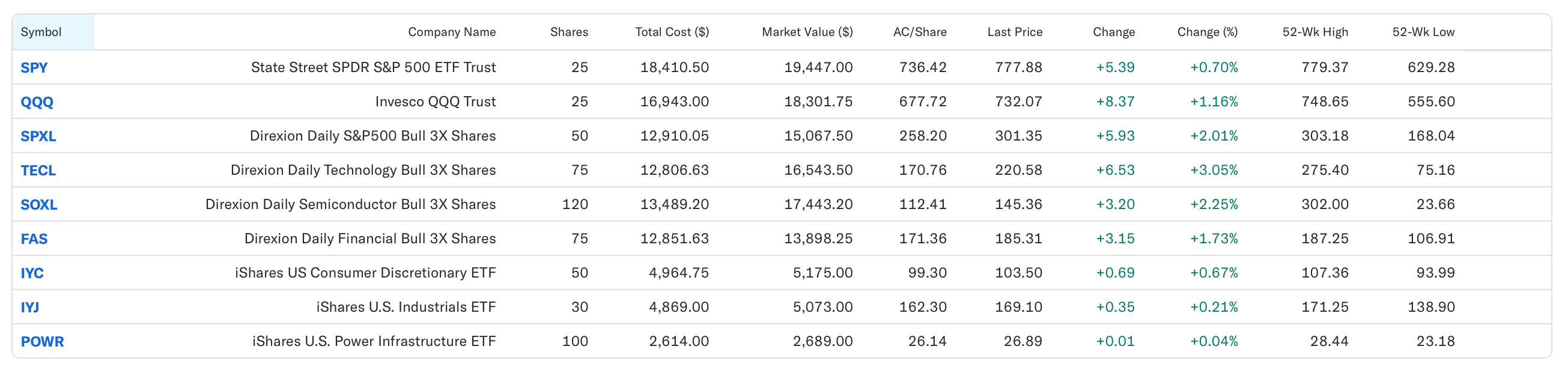
Below are the portfolio holdings. Over the coming weeks, I’ll touch on some of the finer points related to the ETFs in each portfolio. To reiterate, the portfolios are heavily skewed to the US and technology. I remain a proponent of strong returns over long periods, driven by tech returns and tech deployment, principally AI deployment in the coming few years.
👉 Not a subscriber? Access the portfolios for free by subscribing below!
Foundation Portfolio

Momentum Portfolio
Hyper-Frontier Portfolio
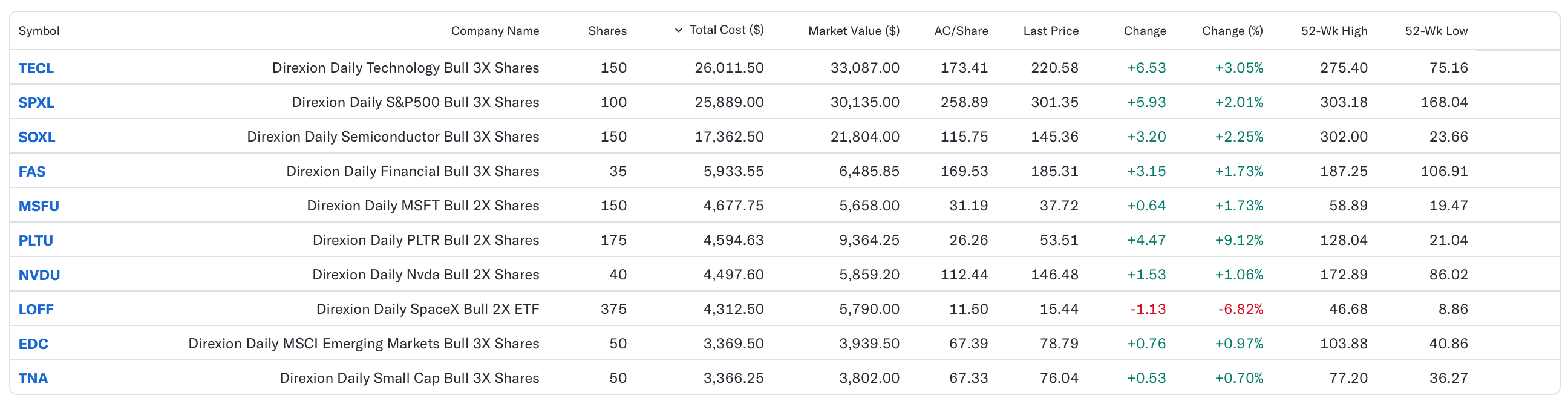
As mentioned, in each portfolio, the largest holdings are centered on S&P500 and technology (e.g., QQQ). Given the smaller size of the portfolios, I’ve chosen not to include a “pure” counter strategy (i.e., stocks that do better when core holdings are down, such as Healthcare).
No doubt, more advanced investors will identify a very large degree of overlap amongst the ETFs (where similar stocks are held within multiple ETFs). This is intended—an active decision to bring higher levels of concentration risk early in the process. Then when appropriate, paring and rotation will occur as the bull market ages.
Finally, no, I do not have a “marketing agreement” with Direxion or iShares (by BlackRock), or any financial firm. You see a long list of ETFs produced by these names simply because I have experienced them for so many years. They are innovators, so I am naturally drawn to their products. My degree of trust for their offerings is high.
I welcome your feedback and comments. Just click below with any thoughts.
Have a great weekend!
This publication is for brains, not bets. The Other Side of Obvious shares ideas, stories, and general financial information—not personalized investment, tax, or legal advice. Investing comes with risk (including losing money). Talk to a pro before you act. Please take time to read these important disclosures before you get started.
Reliable data shows that “trading” does not work out well for most investors. If by “work out well” we look at trading outcomes over long periods of time.
While I personally hold some positions in the following portfolios, the model portfolio holdings are for illustrative purposes only. Please read this disclosure.
There is no particular reason for this start date. I still believe that “time in the market” will always outperform attempts to “time the market.” However, anticipating the pullback during late June and into July would dissipate, I chose 30 July to start.
I believe that managing emotions requires repetitive practice during volatile market conditions.
Note that many of the ETFs shown are available for trading on US exchanges.