

Following is another update on the “Ascend” portfolios, originally published on August 14 (see below), as well as a few comments on market conditions.
The "Ascend" Portfolios

For a while I have considered creating model portfolios that readers can track along with—in fact, 3 portfolios built with a specific rationale for each stage of a self-investor’s journey and designed for scale. I am pleased to provide the first versions of these portfolios below.
As a reminder, each portfolio provides for a discrete level of experience:
Foundation: a simplified ETF portfolio creating the groundwork for future development.
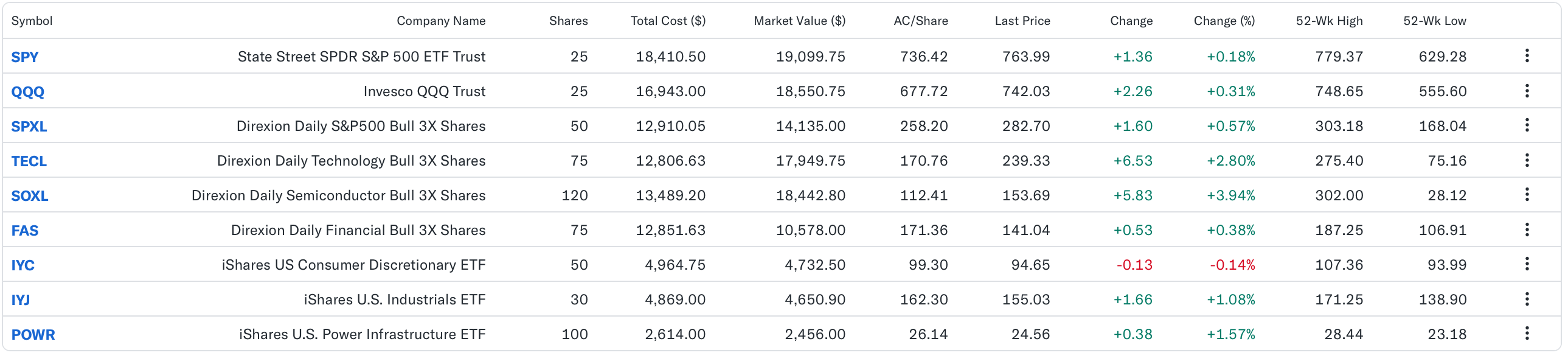
Momentum: a ETF portfolio that builds confidence and range. It pushes boundaries and risk, while priming an investor for greater degrees of volatility.
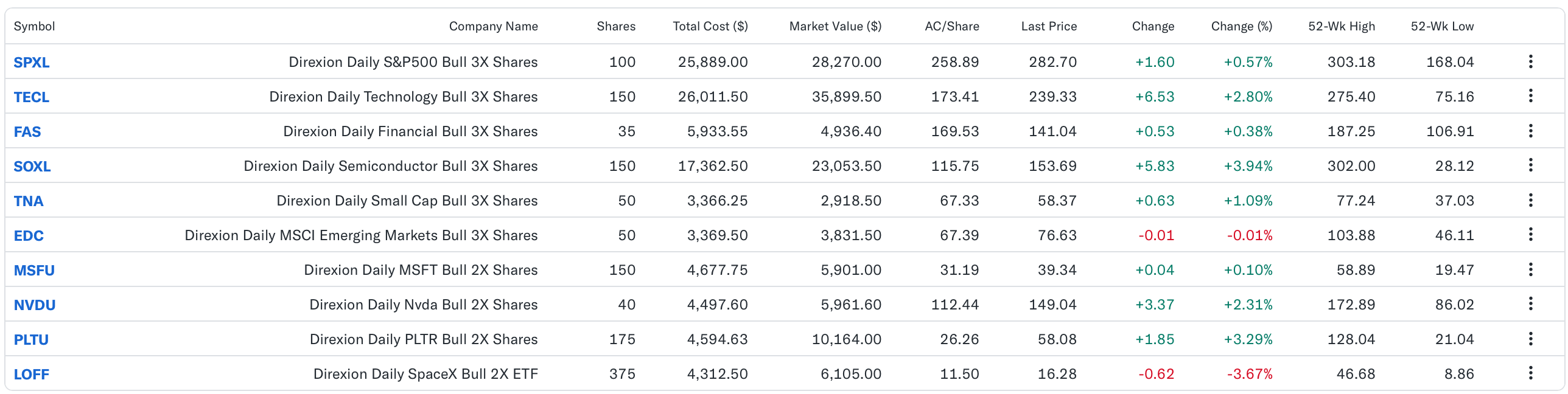
Hyper-Frontier: a hyper-ambitious portfolio, that refines and expounds on learned risk-taking.
(Please be sure to read my disclaimers, if you haven’t already.) 1
Portfolio Performance
Following is an update on the portfolios through Week 8 (1 October, 2026), since inception of 30 July, 2026.
The Ascend portfolios remain in a positive position since inception. Time has shown that even the worst news (Iran uncertainty, bond market chaos, even the threat of an AI-pocalypse) gradually loses its power to surprise.

👉 Not a subscriber? Access the portfolios for free by subscribing below!
Foundation

Momentum
Hyper-Frontier
ETFs in Focus
AI continues to be a major theme, but as discussed below, the narrative will rapidly migrate from “Wow! What a great technology!” to actual read-world commercial results. For those hesitant to commit to pure “AI plays”, the S&P 500 is where those AI benefits will begin to show up, particularly into 2027. So, keep an eye on SPY 0.00%↑ and SPXL 0.00%↑ as proxies for “AI diffusion.”
AI Diffusion

I highly recommend reading Chang Che’s piece in the New Yorker about the so-called “A.I. Race” with China. Long story short, there isn’t one. But the article delves into how technology spreads, and in the case of AI, how it will diffuse. Based on the views of Nathan Rosenberg, a technology historian, the article stresses how “first mover advantage” is relied on more than it should be.
So, smart investors should be wary of focusing only on “frontier” AI companies and their latest models, and more so on the “broad middle”—how AI will burrow its way into the public and commercial sphere as adoption takes hold. Furthermore, investors should refuse to accept the latest threat (e.g., China dominating in AI, “swarms” of agents killing us all) as a “near-term forecast.” The road to any extreme prognostication is paved with bureaucracy and complications!
Finally, watch for AI diffusion as it is happening, particularly in America’s leading companies (S&P 500). Listen for how quarterly reports are emphasizing (or de-emphasizing) AI adoption. In the early phases of AI diffusion investors will need to look for cues (i.e., subjective cues) that progress is being made, until there are more reliable measurement tools (i.e., objective data) available that will better interpret the impact of AI adoption).
Outlook
Recent reports show inflation stabilizing in the US, and economic activity improving. This offers some relief for those who fear an impending recession. The US mid-term elections will be the critical focus in the coming weeks. Markets care more about gridlock in Congress, which usually means less risk of legislation passing that could be economically disruptive.
Once the elections are past, expect markets to pick up pace, in anticipation for more clarity on Iran and interest rates. I anticipate markets finishing strongly positive for the year, but not without pullbacks along the way. Q4 is expected to be an interesting quarter for markets.
Have a great weekend!
This publication is for brains, not bets. The Other Side of Obvious shares ideas, stories, and general financial information—not personalized investment, tax, or legal advice. Investing comes with risk (including losing money). Talk to a pro before you act. Please take time to read these important disclosures before you get started.
I am a long-term investor focused on extended periods of performance (i.e., 10-20 years), using few, if any, short term bouts of trading. So, there won’t be a lot of movement in these portfolios.
This is not investment advice nor a recommendation to buy or sell certain investments. The intent of these portfolios is to illustrate the thinking behind the investments in the hopes that the reader might translate these ideas into his or her own portfolio in an appropriate and suitable way.
These model portfolios each contain levels of risk. In particular, the “Momentum” and “Hyper-Frontier” models contain leveraged products that are not suitable for all investors.
If you don’t have an investment goal, please start one. Here is a useful article on how to begin.
If you need help building your own portfolio, consider reading “How to Design a Model Portfolio.”