

This publication is politically agnostic. We evaluate developments, regardless of party or politician, for their economic and market effects only.
Despite a decisive victory in the Mid-Term elections, the Democrat’s majority in the Senate fell a few seats short of a veto-resistant super-majority. That means the President can veto any major legislation that he disagrees with. That’s gridlock.

Markets love gridlock. A state where big, sweeping legislative changes are largely limited. It doesn’t mean elected officials stop working. Bills will be passed and a lot of effort will be made: setting committee agendas, regulatory policy, and holding hearings. Anticipate a lot of hearings to follow.
In other words, expect the volume to go up considerably in the coming few years. Hearings and committees are important, but they aren’t legislation. Democrats may put together AI regulatory policy, for example, but it has little hope of getting agreement from the President.
OK, so what happens next?
How Do Markets React?
Historically, the S&P 500 tends to have its best year in the third year of a US presidency, regardless of which party is in power, and regardless of whether one party holds a majority in Congress or not.
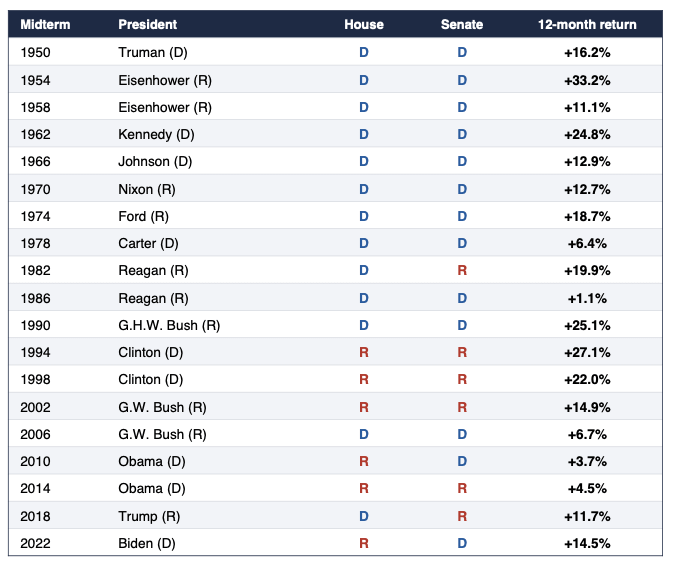
The S&P 500 was higher 12 months after every one of the 19 mid-term elections since 1950, with an average price gain of +15.1%. Party control made little difference: the average was 14.7% under Democratic presidents (9 elections) and 15.5% under Republican presidents (10). Divided government averaged 15.1% (14 elections) and unified government 15.0% (5 elections).
However, that doesn’t mean there will be smooth sailing. Most years experience short term volatility, including corrections. So far, we’ve already seen how markets react when there is uncertainty.
Last week’s steep fall of Tech, AI and Semiconductor stocks was a reaction to uncertainty over whether the Democratic majority tries to enforce stringent regulation on AI, attempt to limit data center building and other efforts to quell surging technology companies (and the uber-rich associated with those companies).
Ultimately, markets tend to perform well when economic fundamentals remain strong and legislation remains tepid or non-existent. So, the question becomes how likely is it that Democratic control of Congress leads to major legislative change—actions that could rattle stock markets?
We have already confirmed that Democrats hold a majority, but not a super-majority. Any attempts at major reforms will likely be hard fought, and with a high percentage that President Trump would veto. The probability of major legislation in the coming two years is low.
So, what will the Democrats be focused on? The way the Democrats swept the mid-terms might offer a clue.
Democratic Win or Republican Loss?
After every election there is a lot of finger-pointing. Republicans blame the loss on the Iran dilemma or stubborn inflation or Trump. Democrats point to their agenda and to the will of the electorate to stop “inequality.” One side “won” and the other “lost.” Or perhaps, one side successfully “didn’t lose” and the other successfully defeated itself.
But what did the voters actually reveal in this election? Let’s look at approval ratings for a clue. Several days before the election, NBC ran a party favorability poll. The results are surprising:
Republicans: 38% Positive Opinion / Negative Opinion 50%
Democrats: 29% Positive Opinion / Negative Opinion 52%
This result mimics trends seen over the summer—that swing voters are backing Democrats despite their poor favorability ratings.
However, there is more to the story. How do voters view other political and business figures, relative to political parties?
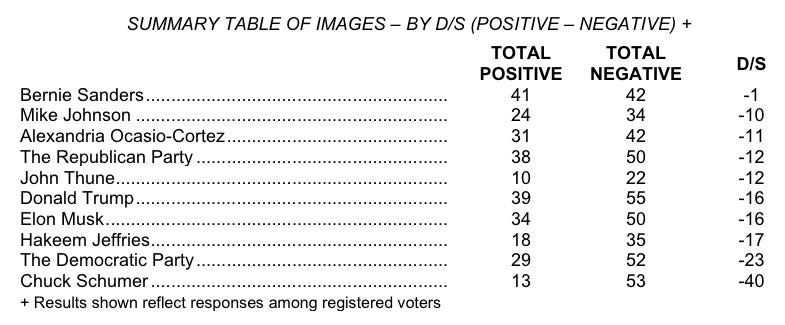
Strange, indeed. The Democratic Party and the Senate Leader, Chuck Schumer, are among the least favorite in this sampling. Yet, the same NBC poll reveals most prefer a Democratic-controlled Congress (52% preferred vs. 45% Republican), inspire of the unfavorable view towards Democrats.
What’s up with that?.
A Vote For or Against
The above data, as well as other surveys, indicates that voters weren’t voting Democrats into power, as much as they were retaliating against President Trump—including those associated or aligned with him. It seems pedantic to talk in such terms, but voters clearly were rebuking Trump. The reality is that both parties are unpopular, as is the President.
The same NBC poll sheds some light on what matters most to the American electorate:
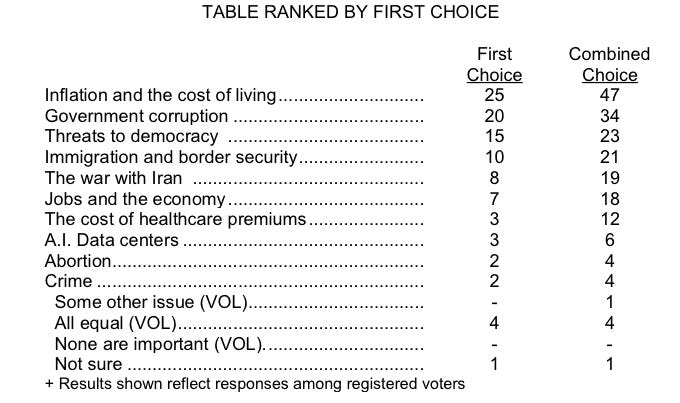
The cost of living and corruption came out on top. Not Iran, not AI data centers, not healthcare premiums (shocker!), not even jobs and the economy rank in the top five. 51% of those polled indicated “dissatisfaction with personal finance” as a reason for voting in Democrats.
The angst over cost of living (i.e., “affordability”) is most on the minds of the American public. Will Democrats focus on this issue?
What to Expect
The larger (and more immediate) decisions facing Democrats are more likely:
Party Leadership & Direction: What about Chuck? Mr. Schumer’s leadership role may be in jeopardy. He stands for the institutionalized wing of the Democrats, whereas Progressives are looking for change. (Let the in-fighting commence.)
Party Agenda: what do they actually stand for? As opposed to what is the issue-du-jour. What policy agendas do they put their efforts behind, especially in regards to American’s concerns over affordability?
The White House: What about Trump? Do Democrats make an all-out attack or a more nuanced approach? Some are calling for impeachment. But that could risk re-galvanizing support amongst Republicans.
AI Regulation: This will be a priority for Congress, and with that reality the issue will be less about whether there is regulation, but how restrictive it is. Expect proposals, but debates will become long and drawn out.
Data Centers: While there were some decisive victories on local ballots, such as restrictions or prohibitions on building data centers, it is less likely Congress will attempt sweeping reforms on a national level. Big decisions come with the potential for a big backlash. And without that super-majority, attempts at big reforms becomes a riskier gamble.
Government Debt: In my opinion, how Congress addresses Government spending will be one of the largest factors in their ability to be re-elected in 2028. There is no escaping the reality of Biden’s over-spending; and, to attack the Trump administration on this subject, means Democrats will need to exercise fiscal prudence.
When it comes to taxes, local ballots had some “victories” taxing the wealthy (e.g., Washington and Colorado). However, California’s proposition to tax billionaires seems like it won’t survive the final count. The backlash against the wealthy will likely continue, but in my opinion this a sub-issue—a tangent on the “affordability” debate and an expression of financial inequality.
Of course, there are pressing geo-political issues as well: Iran, Ukraine, European debt crisis, Israeli leadership, etc.. And, tariffs. If anything Congress could accomplish, it could be the unwinding of tariffs. If handled well, this could help shore up support in coming years, and potentially impact the affordability issue.
I expect a large dose of the above, although mostly rhetoric and antics. Activity that looks good in the news. A lot of noise and vitriol, hearings and committee meetings. But no major legislation. None that will get far, fast. But enough media coverage that it will continue to drive market volatility along the way.
I could be wrong. But if historic patterns hold up, we should see a strong market in 2027.
This publication is for brains, not bets. The Other Side of Obvious shares ideas, stories, and general financial information - not personalized investment, tax, or legal advice. Investing comes with risk (including losing money). Talk to a pro before you act. Please take time to read these important disclosures before you get started.