

Summary
Political opinions are not investment signals.
Early presidential terms historically carry more volatility and policy risk.
Late-term periods, especially year three, have been the most equity-friendly.
Markets discount fear faster than voters do.
The goal isn’t prediction; it’s probabilistic positioning.
When I began working for Ken Fisher, one lesson arrived early and stuck fast: politics and portfolios should never share the driver’s seat. I gradually learned to become politically agnostic (neutral) when it comes to politics and investing.
Not because politics are irrelevant, but because political attachment corrodes judgment. Once an investor starts rooting, booing, or moralizing, decision-making narrows. Inputs diminish. Risk rises.
Political conviction, when smuggled into investment choices, behaves like an analytic toxin. It crowds out economic data, sentiment, valuation, liquidity, and probability. Ironically, these are very ingredients markets actually digest.
A Recent Reminder
Take 2025. A meaningful cohort of investors dismissed U.S. equities outright due to the Trump factor. When tariff-heavy policies rattled global markets, they felt vindicated. Staying out felt prudent. Until it didn’t.
As tariff shock morphed into tariff familiarity, markets did what they always do: adapt, discount, and move on. Economic data surprised to the upside. Stocks recovered. Those who’d exited for political reasons paid an opportunity cost that no ideology reimburses.
Personally, I find broad tariff strategies economically clumsy (and unnecessary). BUT, that opinion never touched my portfolio. Experience teaches you this discipline the hard way—often by watching others repeatedly fail to learn it.
Over the years, I saw clients liquidate portfolios because “their party” lost an election. This sort of damage is not ideological. It is purely mathematical damage. (The market doesn’t care about investors’ votes or for party politics.) Missing a market recovery is far more lethal to long-term goals than enduring volatility.
Rather than fight politics, I prefer to use it.
That’s where the Presidential Term Cycle, often mislabeled an “anomaly,” enters the conversation.
The Presidential Term Cycle (Anomaly)
Ken Fisher outlines this pattern clearly in Debunkery and related research (including The Only Three Questions That Still Count). The idea is behavioral, institutional, and painfully human, rather than merely mystical.
The historical pattern:
Years 1–2: The Danger Zone
Early terms are legislative heavy-lifting seasons. This is when administrations attempt the boldest redistributions - taxes, regulation, property rights, entitlement reshuffling. Even when laws fail, the threat of change injects uncertainty. Markets dislike uncertainty more than bad news. Historically, the ugliest drawdowns cluster here (see S&P 500 returns in the chart below).
Two Bad Years Rarely Travel Together
While early-term volatility is common, back-to-back deeply negative years are uncommon. Fear tends to peak early and markets tend to exhaust pessimism faster than headlines do.
Years 3–4: The Sweet Spot
As re-election looms, political incentives flip. Stimulus replaces austerity. Stability trumps disruption. Year three, in particular, has historically delivered the strongest equity returns of the four-year cycle.
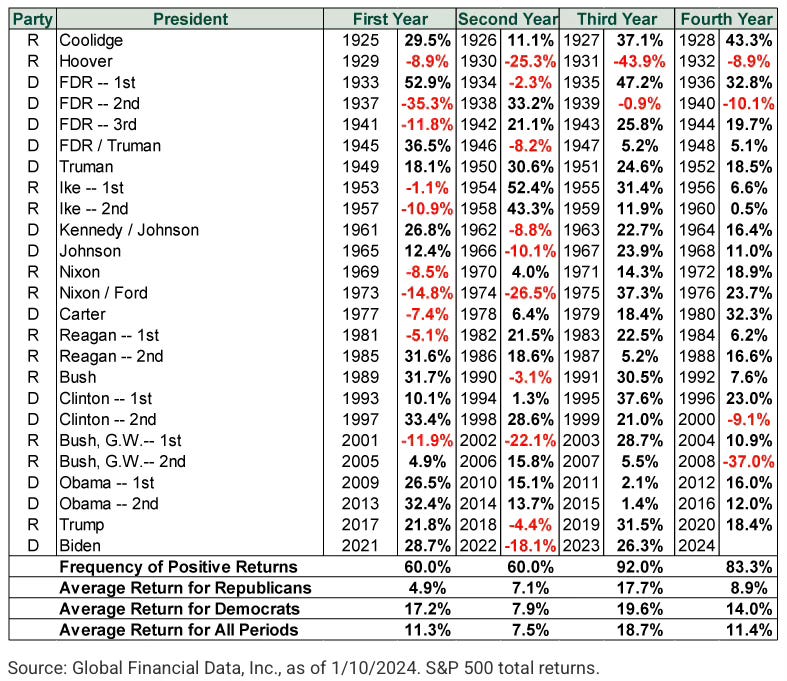
This is not prophetical, but simply pattern recognition across decades of data.
Stocks don’t vote. They respond to policy risk and policy restraint.
How to Become Politically Agnostic as an Investor
Political neutrality doesn’t mean political ignorance. Taxes matter. Regulation matters. Fiscal posture matters. What doesn’t help is emotional allegiance.
So, here’s how to operationalize detachment:
First: Separate awareness from attachment.
Be aware while remaining detached. Stay informed, but audit your emotional temperature. If a policy headline makes you angry or gleeful, pause. Emotion is a signal. Do NOT use it as an instruction.
Second: Exploit the system instead of protesting it.
If your preferred candidate loses, resist the urge to sulk in cash. Instead, recognize the cycle. Early-term anxiety often plants the seeds of later gains. Call it electoral arbitrage. As Fisher likes to say: stocks don’t pick sides. Why should you?
Third: Practice subordination of belief.
This is the hardest step. We humans are narrative animals trying to make sense of machine-like markets. The two rarely agree.
Fear—especially politically flavored fear—feels rational in the moment. It almost never is. (There’s ample research showing fear-driven decisions systematically degrade outcomes.)
Before acting on a politically charged impulse, ask yourself:
How does this move me closer to my actual financial goals?
If I’m wrong, what’s the cost? Not just emotionally, but numerically?
How can I use the Presidential Term Cycle instead of fighting it?
A Closing Thought
You are free to hold strong political views. You are not free from the consequences of letting them influence the management of your money.
The politically agnostic investor doesn’t ignore elections. The agnostic investor looks for ways to monetize them. By subordinating ideology to evidence, and emotion to structure, you give yourself a durable edge.
In markets, neutrality isn’t passivity. It’s leverage.
This publication is for brains, not bets. The Other Side of Obvious shares ideas, stories, and general financial information - not personalized investment, tax, or legal advice. Investing comes with risk (including losing money). Talk to a pro before you act. Please take time to read these important disclosures before you get started.