

SpaceX’s proposed valuation for its imminent listing on Nasdaq re-introduced the spectacle-factor, not seen for a while. Regardless of one’s estimation for a more realistic valuation or not, the listing on Nasdaq presents a vivid dream: investor’s can, in a sense, own a piece of the amazing spectacle we call Space.

Space exploration and the “space economy” is a frontier story. So, tread with caution. But…this frontier story is unmatched. And it’s one where the seeds are already being planted. Space commerce is wide open (literally) and as such can seem overwhelming. But just a cursory view of the opportunities should get anyone to stop and look up.
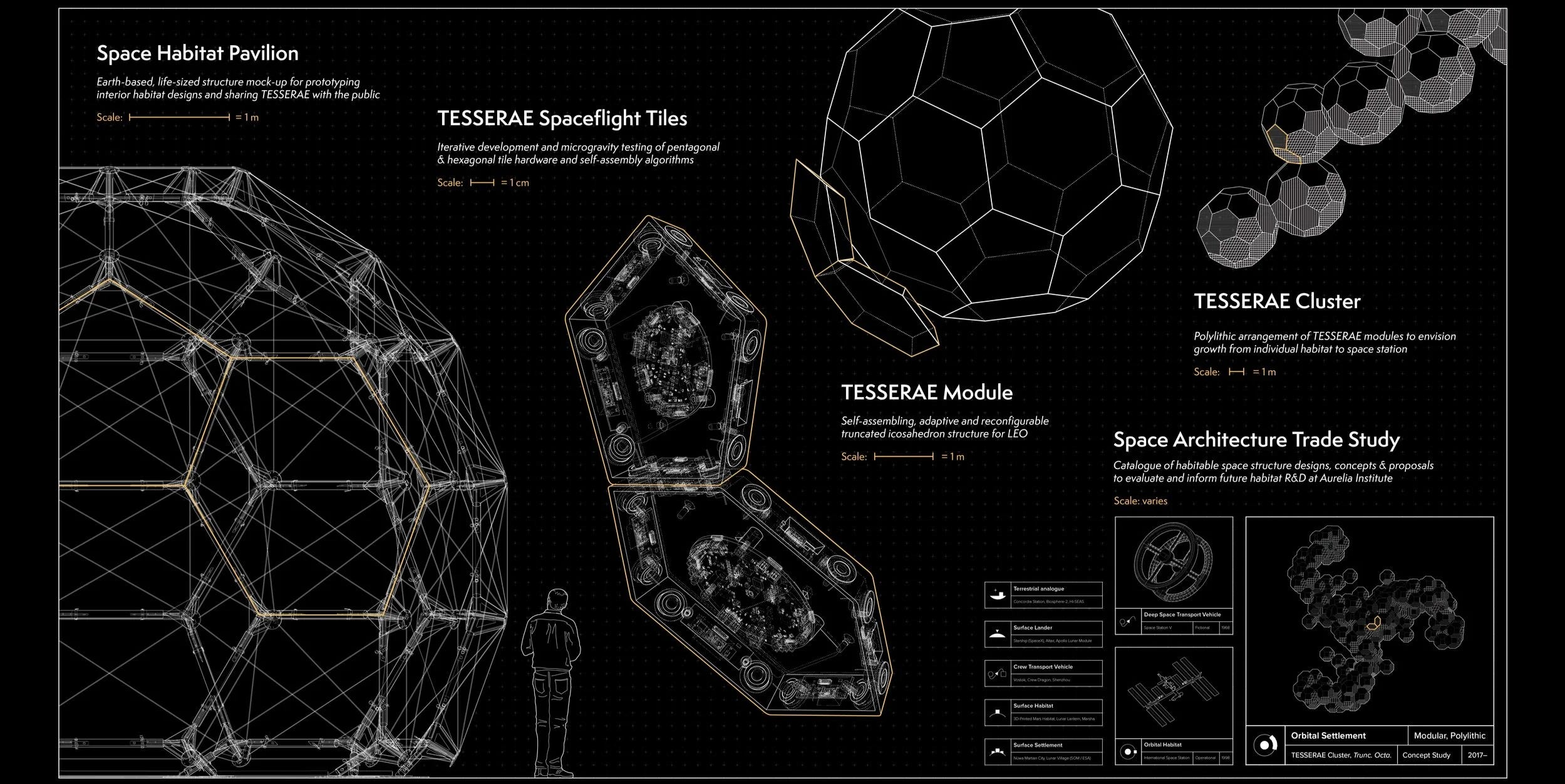
I was utterly intrigued by a presentation from Aurelia Institute’s chief executive Ariel Ekblaw, in which she described how self-assembling magnetized structures could make orbiting research habitats a reality (in the not too distant future). And, what’s more, microgravity research shows the potential for unlocking scientific and medical breakthroughs that only the weightless environment of space can deliver.
While SpaceX is the first mega-spectacular entrant to public markets, there are multiple organizations continuing to lay the groundworks SpaceWorks for the interstellar economy.
Consider a few potential areas of development that the Space Economy presents:
New Medicines and Biotech Discoveries. Microgravity changes how cells, proteins, and tissues grow. Researchers have already found that protein crystals grown in orbit can be more uniform and detailed than those grown on Earth, potentially improving drug development. The potential benefits? Faster drug discovery, better cancer therapies, improved regenerative medicines, more realistic human tissue models for testing.
Scientific Discovery: Just looking back, should help us see forward. Exploration has generated unexpected technological breakthroughs. Past space programs contributed to innovations that eventually influenced medical imaging, materials science, computing, telecommunications and consumer electronics.
Planetary-Scale Internet Connectivity: Satellite constellations are already shrinking the digital divide bringing greater connectivity to rural areas, remote education, telemedicine, emergency communication as well as maritime and aviation communications.
Orbital Data Centers: Taking the compute infrastructure out of our backyards and sticking them into orbital centers. Advantages include continuous solar power, reduced strain on power grids, direct processing of satellite data (without the back and forth from earth to satellite).
SpaceX is not alone in this particular pursuit. Companies such as Orbital AI Factory and Starcloud are pursuing variants of this idea.
Material Manufacturing: Many industrial processes are affected by gravity-driven convection, sedimentation, and contamination. In microgravity, manufacturers may be able to create: ultra-pure semiconductor materials, high-performance crystals, precision optical components, advanced fiber optics.
Researchers have already demonstrated in-space manufacturing of optical lenses using microgravity fluid dynamics.
So, what about SpaceX?
Many commentators are building their narrative of the SpaceX listing around the valuation. And secondarily, a sub-narrative which tunes into (i.e., over-obsesses about) Musk becoming a trillionaire.
Be a smart investor. Think long-term. Consider whether taking a position in SpaceX is or isn’t your business. And mostly, ignore the noise and listen/look for the signal.
Observing the spectacle that is Elon Musk (admittedly, with his own gravitational pull) may cause some to refrain from buying SpaceX. But don’t be fooled by the flash and drama.
SpaceX could pop, drop and/or stabilize. And there will be others to join the public markets, such as, Blue Origin, Rocket Lab, Astral Materials and others.
But the Space Economy will take off. McKinsey & Co estimates $1.8 trillion by 2035. That sounds great. Whether or not we can rely on it…well, I’m not going to wait and see.
Because my thesis to own a bit of Space is this:
Ignore the IPO. My former boss always reminded investors that “IPO = It’s Probably Over-priced.” From an analytical perspective every IPO is mis-priced. It doesn’t matter because markets sort that out with ease. But I am not interested in the IPO. I am interested in the opportunity to buy into the Space market. Why?
Look for frontiers. Space is the “final” spatial frontier (it happens to be infinite from what we can tell).
Only a small stake is required. (Money that I can afford to lose if the frontier takes longer than expected to be subdued).
Think bigger and further out. All the analysis, predictions and forecasts in the world couldn’t convince me for or against investing in the Space Economy (i.e., I already have a conviction and its ultra long-term). So, why not start now?
Identify disrupters. Invest in disrupters, the more annoying the better; those who gravitate towards the volatility and the unbelievable. Those who are “anti-fragile.”
Buy signals. There are soooo many “observers” and “commentators” railing against making Musk a trillionaire or shouting about how 401Ks will be wiped out. This volume of noise is a clear buy signal.
Skin-in-the-Game. Most importantly (to me anyways), is that I can’t truly learn this new “Space Economy” without having skin in the game.

And, it should go without saying, but as the “Off-World” or “Orbital” economy gains momentum, it leads to an expanded “Exo-Economy” (Greek exo, “outside”). Both terrestrial and space activities become more intertwined. What happens up there directly impacts things down here.
This is not a recommendation nor should it be treated as advice (every investor’s situation and timeline is unique). This is merely a perspective on how I think about investing for the long run. There are huge risks involved in developing a Space Economy. Big leaps forwards, and big disappointments.
Yet, having stared up at the spectacle of Space for a long time, it is difficult not to envision the opportunity. I am grateful to be around to witness it.
So, reach for the stars (or not). Regardless, proceed with caution.
Let the countdown begin…
This publication is for brains, not bets. The Other Side of Obvious shares ideas, stories, and general financial information - not personalized investment, tax, or legal advice. Investing comes with risk (including losing money). Talk to a pro before you act. Please take time to read these important disclosures before you get started.
Very interesting read, esp for the young generation....