

In part 2 of this series, we consider what it takes to “pre-tire.” Check out part 1 here.
📌 The Quick Hit
Pre-tirement is a lifestyle redesign that starts now, not at 65.
Retirement is more than a spreadsheet problem. It’s an identity puzzle, a purpose question, a “how do I want my mornings to smell?” kind of thing.
You don’t need millions to begin; you need intention, clarity, and a certain stubbornness about protecting your time.
Start experimenting: reduce commitments, try flexible work, carve out identity beyond your job title.
If you wait until “after I retire” to figure out your ideal life, it’s usually too late.
💡The Idea That Seems Obvious (But Isn’t)
Obvious:
“Retirement is a financial achievement.”
The Other Side of Obvious:
If money alone guaranteed great retirements, wealthy people would never fall into purposelessness, depression, anxiety, or the feeling of drifting in a world without structure. And yet they routinely do.
I witnessed this firsthand during my own work in financial services. Daily I would speak to high net worth investors who sounded lost. Counting their money, but with little idea of how they would use it for something better.
Retirement planning is behavioral, psychological, logistical, relational, and philosophical. Money buys time, but it does not automatically buy meaning.
The real dividend of money is autonomy, not amusement. (@morganhousel)
The punchline: retirement without a pre-tirement is a lifestyle vacuum. And nature hates a vacuum.
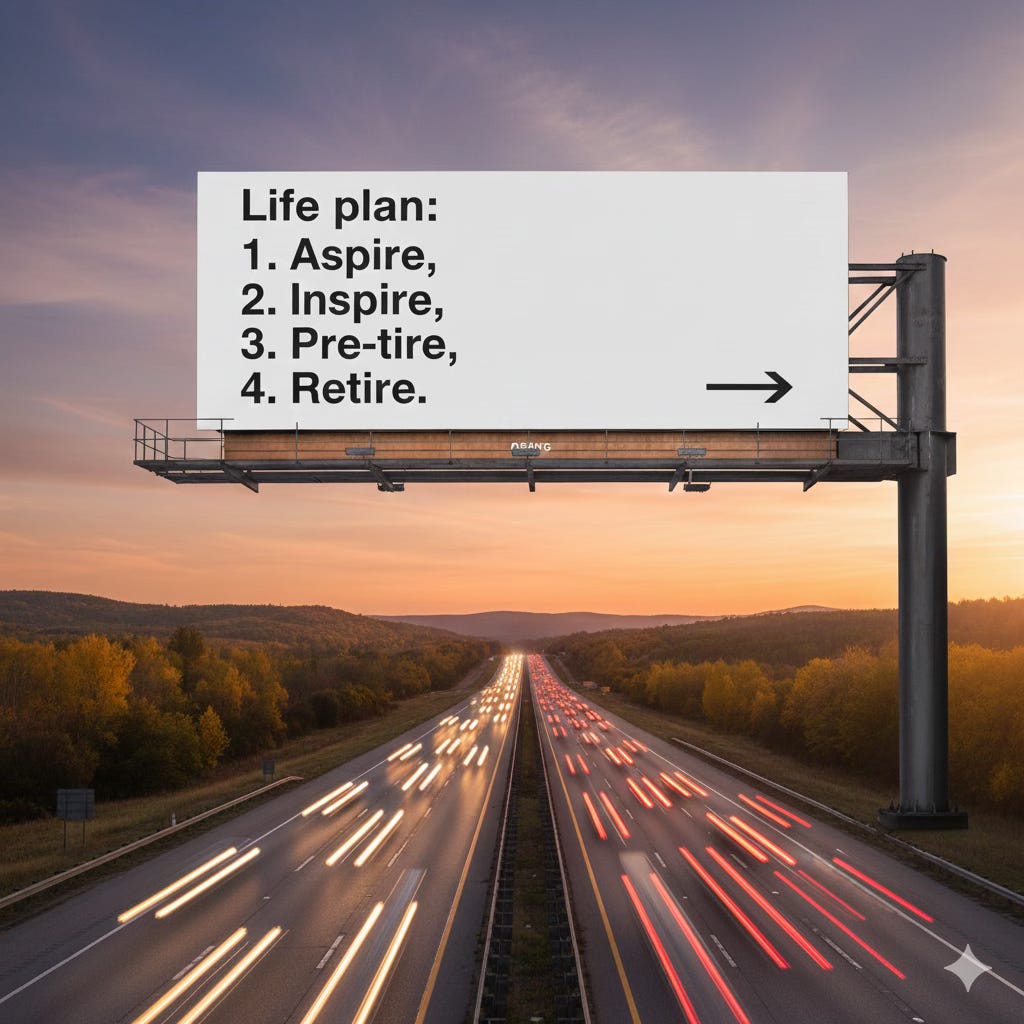
❓Why Pre-tirement Exists at All
Pre-tirement is the stage between “full-tilt career mode” and “I’m done - where are my golf clubs?” It’s a deliberate tapering - financially, emotionally, socially, and professionally. Think of it as the dimmer switch instead of the lights-off switch.
It’s where you practice the life you want while still earning and participating in the world. This phase can last five years or thirty. Start at twenty-five or start at seventy - earlier just gives you more reps.
🧠 The Intellectual Backbone
1. Purpose Is a Design Project
You cannot retire into meaning you haven’t defined. Lifestyle comes first; work is engineered around it.
As Cal Newport’s body of work teaches: the question isn’t “What job will I do?” but “What kind of life do I want this job to support?”
2. Money = Time Control, Not Endless Amusement
Wealth is neither luxury nor prestige - it’s the power to structure your schedule.
“Money’s greatest intrinsic value is the ability to give you control over your time.” (@morganhousel)
Pre-tirement therefore focuses less on “how much is enough?” and more on “how much autonomy am I buying?”
3. Emotional Fitness > Numerical Precision
Your mental circuitry likes routines, rhythms, and projects.
An abrupt shift from 60-hour weeks to 0 can feel like slamming into emotional air pockets.
Pre-tirement allows you to practice identity change while keeping stakes low.
4. Discomfort Builds the Good Stuff
Michael Easter’s work on voluntary discomfort reminds us: optimal lives aren’t built out of softness alone.
Choosing to be challenged, learning new skills, trying unfamiliar leisure, rethinking habits - prepares you for a retirement that’s vibrant rather than stagnant.
Personally, I began an obsessive pursuit of squash and calisthenics well before I even decided on a “final” date to “pre-tire.” But I was mindful that I was building a foundation for the future.
🛣️ How to Actually Pre-tire
Step 1 — Craft Your Ideal Week Before You Chase It
Not your ideal retirement. Your ideal Tuesday:
What time do you wake up?
What’s your first hour like?
Who do you see?
What energizes you?
What absolutely cannot exist in that life?
Without this clarity, retirement is just an extended weekend…which quickly becomes an existential Monday.
Step 2 — Reframe Money as a Tool for Autonomy
Instead of asking “How much do I need to retire?” ask:
How much do I need to work less without panicking?
How much do I need to change careers without fear?
How much do I need to buy back mornings?
Savings, investments, pensions, flexibility - all of it is fuel for freedom.
Not consumption. Not bragging rights.
Freedom.
Step 3 — Prototype the Lifestyle
Before the big leap:
Negotiate part-time work or fewer days.
Take a sabbatical.
Try a 9-month work year.
Build small income streams that feel playful rather than soul-sucking.
Join communities now, not when you’re already adrift.
Testing the lifestyle is better than fantasizing about it.
Step 4 — Rehearse Identity Change
If your identity is welded to your job title, retirement can feel like being erased.
Try:
Volunteering in fields unrelated to your career.
Taking on “apprentice-level” hobbies (the ego-denting kind).
Writing, creating, teaching, or mentoring.
Building a social world that doesn’t orbit your professional role.
Step 5 — Expect the Plan to Break
Life will complicate things.
Health, family, markets, politics, surprise opportunities - something will reroute you.
So, plan to build flexibility into your pre-tirement framework.
🛠️ Practical Takeaways (Make These Moves This Month)
Journal your ideal week. If you can’t describe it, you can’t fund it.
Track your time for 7 days. Compare reality vs. your ideal - and close one gap.
Automate savings increases. Buy more freedom each month.
Test one “pre-tirement block.” Try taking two Fridays off each month for lifestyle experimentation.
Build a small, joyful income stream. Something that doesn’t feel like labor - teaching, consulting, selling know-how, creating.
Practice boundaries. If you can’t control your time now, you won’t magically master it later.
Add one new community. Retirement without people is a desert.
Schedule one challenge. A class, a hike, a difficult new skill - something that makes you feel slightly incompetent (in the best way). 😬
✨ The Big Idea
Retirement itself has always sounded binary: you’re either “working” or you’re “done.”
But that framing belongs to a bygone era - one where people had pensions, one employer, and a predictable arc.
Today, the people who age well, stay sharp, create meaning, and feel grounded are the ones who approach retirement as a long runway, not a final stop.
Pre-tirement is simply the art of living the life you want… early and often.
It’s not cheating. It’s not indulgent.
It’s intelligent life design.
And the best moment to start? Not at 65. Not at 55.
Just before your life starts rushing by without your permission.
In other words: start now.
🚀 Up Next:
Sunday - Another Perspective on U.S. Healthcare
Thursday - Retirement Series #3: Be Aggressive When You Are Young
This publication is for brains, not bets. The Other Side of Obvious shares ideas, stories, and general financial information - not personalized investment, tax, or legal advice. Investing comes with risk (including losing money). Talk to a pro before you act. Please take time to read these important disclosures before you get started.