

There is a particular kind of anxiety that accompanies rising oil prices. Initially, it arrives with an uneasy sense that something fundamental is shifting beneath the economy. Then the headlines begin to accumulate: tanker seizures, pipeline disruptions, military posturing near strategic waterways. Commentators speak of “energy crises.” Investors begin to imagine cascading inflation, geopolitical escalation, and recession.
Oil markets, dramatic as they appear in the moment, tend to behave less like a permanent rupture and more like a theatrical performance. The chaotic loudness ultimately becomes temporary.
To see why, let’s step back from the headlines and examine how oil has behaved across decades.

Drama Patterns
Every oil spike arrives with the same implicit claim: this time is different.
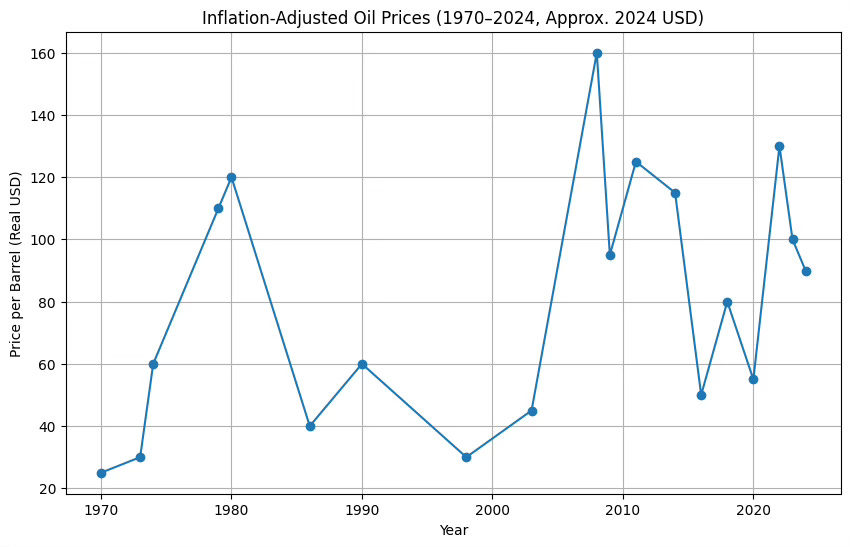
When prices surged during the 1973 Oil Crisis, many believed the industrial world had entered a permanent age of scarcity. Gasoline lines stretched for blocks. Governments imposed rationing. Economists spoke of the “end of cheap energy.”
Yet the oil market is more like a rubber band stretched too far than a drained reservoir. Pull it hard enough and the tension feels unbearable. Ironically, the very forces creating that tension are what eventually snap it back.
Indeed, high prices triggered new drilling, conservation, and technological adaptation. Within a decade, the market was drowning in supply during the 1980s Oil Glut. The same drama repeated itself a generation later. In 2008, oil climbed to nearly $150 a barrel in the months preceding the Global Financial Crisis. Analysts warned of structural shortages. Commentators predicted $200 oil.
Instead, prices collapsed within months. The pattern has been remarkably persistent: crisis > panic > adaptation > normalization.
Hidden Stabilizers
Oil markets possess a self-correcting mechanism. When prices rise sharply, they unleash forces that eventually pull them back down.
The first is demand destruction.
Consumers respond quickly to higher fuel costs: driving less, choosing more efficient vehicles, or shifting spending away from energy-intensive goods. Airlines hedge or reduce routes. Manufacturers redesign processes.
The second is supply response.
High prices act as a powerful signal to producers. Capital flows into exploration. Marginal fields suddenly become profitable. Innovations appear. In the early 2010s, this dynamic helped trigger the American shale revolution, which ultimately contributed to the 2014 Oil Price Crash.
The third stabilizer is technological substitution. Over time, societies adapt via nuclear power, renewables, electrification, efficiency improvements. None of these shifts happen overnight, but collectively they erode oil’s dominance whenever its cost rises too far.
The result is a market that repeatedly overshoots upward and downward.
Numbers That Matter
Yet price alone tells only part of the story. What truly determines whether oil becomes dangerous for the global economy is how much of the world’s income must be spent to buy it.
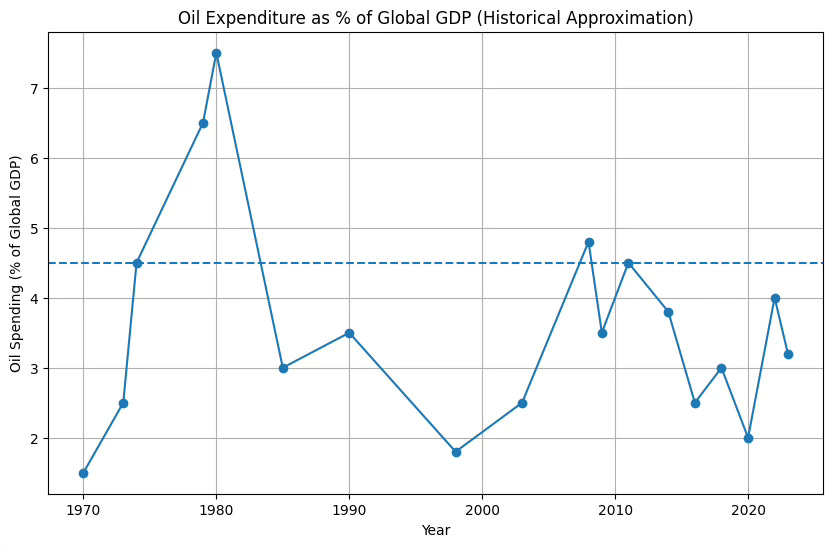
Economists track this through a simple metric: Oil expenditure as a share of global GDP.
When oil prices rise but the economy is large and efficient, the burden remains manageable. But when the share climbs too high, energy begins to function like a massive tax on the entire system.
Recent commentary echoes this historical pattern. Analysts at Reuters Breakingviews and Vanguard have warned that sustained oil spikes eventually compress consumer demand and economic growth. Moody’s chief economist Mark Zandi has similarly noted that nearly every U.S. recession since World War II has followed a major oil shock.
The mechanism is simple: when energy absorbs too large a share of economic output, it begins to function like a tax on the entire economy.
Historically, a clear threshold has emerged. When global oil spending approaches 4 to 5 percent of GDP, recession risk rises sharply.
Even with oil around $100, the oil-GDP ratio today is generally estimated around ~3–3.5% of GDP. That is elevated but below the historical recession trigger.
However, if oil were to reach roughly $130–$150 and stay there for an extended period, the ratio would likely approach the danger zone (~4–5%). [WSJ, Paywall]
Why Crises Feel Larger Than They Are
Part of the reason oil shocks feel existential is psychological. Energy is the bloodstream of modern economies. When its price moves violently, the change ripples through transportation, agriculture, manufacturing, and household budgets.
But the speed of price changes often matters more than the level itself.
A sudden spike compresses economic adjustment into months rather than years. Businesses scramble to reprice goods. Central banks fear inflation. Political leaders warn of crisis.
Yet the market itself is already adjusting. The oil system is like an ocean tanker: slow to turn, immense in scale, but once momentum shifts, the change unfolds with surprising steadiness.
This lag between perception and adaptation is where much of the drama resides.
The Geopolitics of Oil Panic
Geopolitics amplifies the illusion. Conflicts involving energy-producing regions inevitably trigger fears of supply collapse.
Consider the Iraqi invasion of Kuwait, which led to the Gulf War. Oil prices doubled almost overnight. Many expected a prolonged disruption to global energy markets.
Instead, prices normalized within months once it became clear that other producers could compensate.
Even today, investors often overestimate how fragile the oil system truly is. Global production is geographically dispersed, strategic reserves exist across multiple countries, and market incentives quickly encourage alternative supply.
The system bends more easily than it breaks.
The Investor’s Dilemma
For investors, the problem is not the oil market itself but the narrative surrounding it.
Energy shocks generate stories that feel persuasive in the moment: the end of globalization, permanent inflation, structural scarcity.
These narratives often dominate financial commentary precisely when markets are closest to adjusting.
History offers a calmer perspective.
Over the past half-century, most oil spikes have lasted between one and five years. Markets adapt faster than expected. Supply reappears. Demand softens. Prices drift back toward equilibrium.
What appears catastrophic in the present often looks cyclical in hindsight.
The Value of Historical Distance
Investors who examine long-term patterns gain a useful form of emotional insulation.
They begin to recognize familiar rhythms: cheap oil leading to underinvestment, underinvestment leading to shortages, shortages triggering price spikes, and price spikes eventually producing new supply.
The cycle is not perfectly regular, but it is surprisingly persistent.
This perspective does not eliminate uncertainty. Dreaded wars still occur. Markets still overreact. Energy transitions still reshape the global economy.
But it does offer clarity. The oil market, despite its volatility, has rarely produced the permanent catastrophes that seemed inevitable in the moment.
Behind the Curtain
The deeper lesson may be that oil crises are not purely economic events. They are also psychological ones.
Because energy sits at the foundation of modern life, any disruption feels like a threat to the entire system. Headlines amplify the danger. Financial markets magnify the fear.
Yet when the curtain lifts, the machinery behind the spectacle becomes visible: supply incentives, technological adaptation, and the relentless ability of markets to rebalance.
Seen from that vantage point, the oil market begins to look like the volatile, dramatic, but ultimately self-correcting stage in the broader play of global economics.
And in markets, as in theatre, the loudest moment in the performance is rarely the end of the story.
This publication is for brains, not bets. The Other Side of Obvious shares ideas, stories, and general financial information—not personalized investment, tax, or legal advice. Investing comes with risk (including losing money). Talk to a pro before you act. Please take time to read these important disclosures before you get started.