

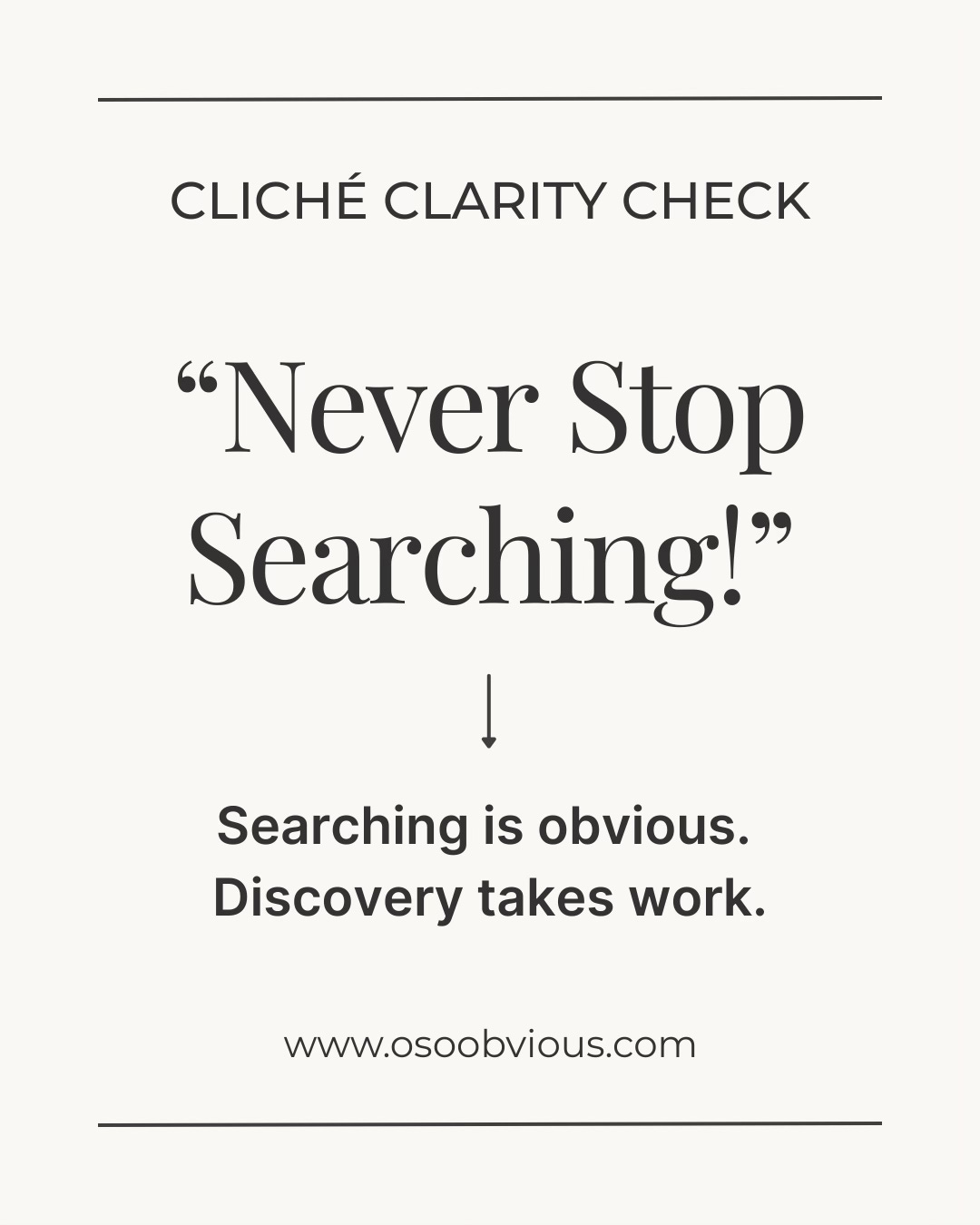
Sounds inspiring, right? It’s a mantra of the curious. The open-minded. The lifelong learner. But what if we take that idea literally? Spiraling through questions hardly seems like a realistic or efficient way to achieve our goals.
So, let’s go deeper.

“Never stop searching” feels noble. It tells us to challenge assumptions, stay open, and keep growing.
“Don’t settle. Don’t get stuck. There’s more truth out there if you’re willing to dig.”
That sounds great until you realize: you can’t question everything all the time. Eventually, you need a home for your beliefs.
If we take the mantra seriously, we’d never trust our job contracts, our friendships, our core values. We’d question gravity on Wednesdays and breakfast on Thursdays. Far from true growth, that’s just chaos.
In real life, healthy search leads to discovery. And when something rings true, we rest in it. Even if we keep our ears open for the next good question.
A Post-it That Changed Me
Back in the early days of the tech boom, I was running a startup in Hong Kong. Every so often, an anonymous letter would arrive. No return address, just a business article clipped from Fortune with a yellow sticky note on top.
One read: “Change is the Engine of Growth.”
I loved it. I quoted it. I used it in boardrooms, strategy decks, and mission statements. It became a sort of compass: change = progress. But years later, something about that line started to itch.
I started asking questions I hadn’t asked before:
• Is all change good?
• When has change backfired?
• What kind of change leads to actual growth?
• Who benefits? Who doesn’t?
And the kicker: “In what way does this change serve something better?” Which of course led to another question: What do I mean by “better”? (That’s where character, values, and real discernment come in.)
The Takeaway: Ideas Shape Us
Ideas are everywhere! Motivational quotes, trending slogans, hot investment tips, memes that sound like wisdom. And over time, they slip into how we think, how we speak, how we invest our resources and how we live.
That’s why how we treat ideas matters big-time.
And there’s one tool more powerful than ChatGPT, Google, or any guru you follow that will help you decipher ideas before they begin informing how you think, believe and live:
Asking the questions that are most appropriate for the occasion.
The AAQ Method (Ask Appropriate Questions)
Here’s how I used it in my 25+ years in the investments world (and still use it everywhere):
1. Start with clarity:
What exactly am I trying to figure out or resolve?
2. Go open-ended:
What am I missing?
Who benefits from this idea or belief?
In what way does this move me closer to my goal?
When clients tried to fire me (and it happened plenty), I rarely took it at face value. The real issue wasn’t fees or performance; it was often fear. So I’d ask:
“In what way does this decision help you reach your financial goals?”
And guess what? That question usually led us to the real story and rational discussion.
Your Turn
Got an idea that drives you? An investment idea?
Before you slap it on a mug or make it your screensaver, try asking (and answering):
What does this idea really say?
What assumptions is it hiding?
From where did it originate?
In what way does this idea actually serve me?
“Never stop searching” doesn’t have to mean you never arrive. It is an invitation to stay curious, humble and be willing to re-think. To find the truths that matter and live from them.
Search wisely. Rest when it’s time. And question the obvious.
This publication is for brains, not bets. The Other Side of Obvious shares ideas, stories, and general financial information - not personalized investment, tax, or legal advice. Investing comes with risk (including losing money). Talk to a pro before you act. Please take time to read these important disclosures before you get started.
Thanks! I hope it helps every investor to keep asking questions!
A good start and motivating, look forward to learning more