

The case for or against buying Anthropic at their IPO depends on intent. Whether an investor is looking to trade with the intent of profiting off short term gains; or, whether to go long. I can’t speak to trading Anthropic, except to say that trading in it doesn’t require any conviction about AI’s future nor the company itself. The only case to be made when trading on an IPO is how willing someone is to bet on the supply/demand hype.
As my former boss enjoyed reminding us, “IPO” stands for “it’s probably over-priced!”
However, for someone with convictions about the long term future of AI—by “long term” we mean at least 5 years and more like 10-25+ years—then, the case for or against Anthropic is one worth considering.
But First…
Let’s address the elephant in the room. To read about the Anthropic IPO seems largely impossible without also hearing about the “AI bubble.” It seems obvious that there is, or could be, or was a bubble. But few bother to ask about the characteristics of bubbles, the main one being that, historically, bubbles are notoriously unnoticeable until they have already formed. Today, everyone sees bubbles everywhere—which suggests two things:
Because an “AI bubble” is widely discussed and has become widely known and widely publicized, it suggests the “bubble” is “discounted” or priced into the market already. It’s lost its power to surprise.
People are displaying a hyper-avoidance of risk. When there is an amped-up abundance of fear (e.g., “OMG, it’s a bubble!”) amidst strong economic fundamentals, that is bullish for stocks.
AI is here to stay. However, the form AI will take—what it will look like in the coming years and decades—will be radically different from what we are experiencing at present. The reality is that we cannot envision the scope of AI’s diffusion and wholesale transformation of economies and markets. Neither could we envision the scale of change the industrialization or railroad.
Unfortunately, many see the Anthropic IPO as a test of AI’s validity as a transformative technology. Well, it shouldn’t be.
So, what is the case, for and against, Antrhopic’s IPO. Let’s consider the size of the offering and relative scale, fundamentals, as well as potential market, regulation and competition; finally, a word on Utopia.
Size & Scale: For or Against?
Some are concerned about the scale of the IPO. That Anthropic’s valuation is just to big. To understand whether that is true or not, we need a measuring stick. Many commentators compare Anthropic to the dot-com boom/bust. OK, let’s compare.
By some measures, the Space-X and Anthropic IPOs would be the rough equivalent of all IPOs between 1999-2000 (raising about $65B or $125B inflation adjusted). Even if you take out Space-X, Anthropic’s IPO is still hyper-scaled relative to the most dot-com listings.
Except, the comparison between dot-coms and Anthropic is simply inappropriate. Instead, one should look at companies that were integral to the internet’s acceptance and to companies servicing and selling over the internet (i..e, dot-com companies). Think: internet search engines, rather than dot-coms
Let’s compare Anthropic with Google. 22 years ago Google raised $1.67B valuing the company at about $23B. Note that this was several years after the dot-com bust, when appetites for over-valued listings was low.
Google was up 18% on IPO and never closed below its listing price. Within a decade it had risen by a multiple of x14. Anthropic’s starting value is much higher comparatively, which leaves less room for that sort of return.
Is Anthropic over-reaching? If so, why?
Fundamentals: For or Against?
Anthropic’s S-1 submission to the SEC shows that its business is clearly accelerating. Third-quarter revenue was $17.0B, and revenue grew 1,127% year over year versus a 382% rise in compute and infrastructure expenses.1
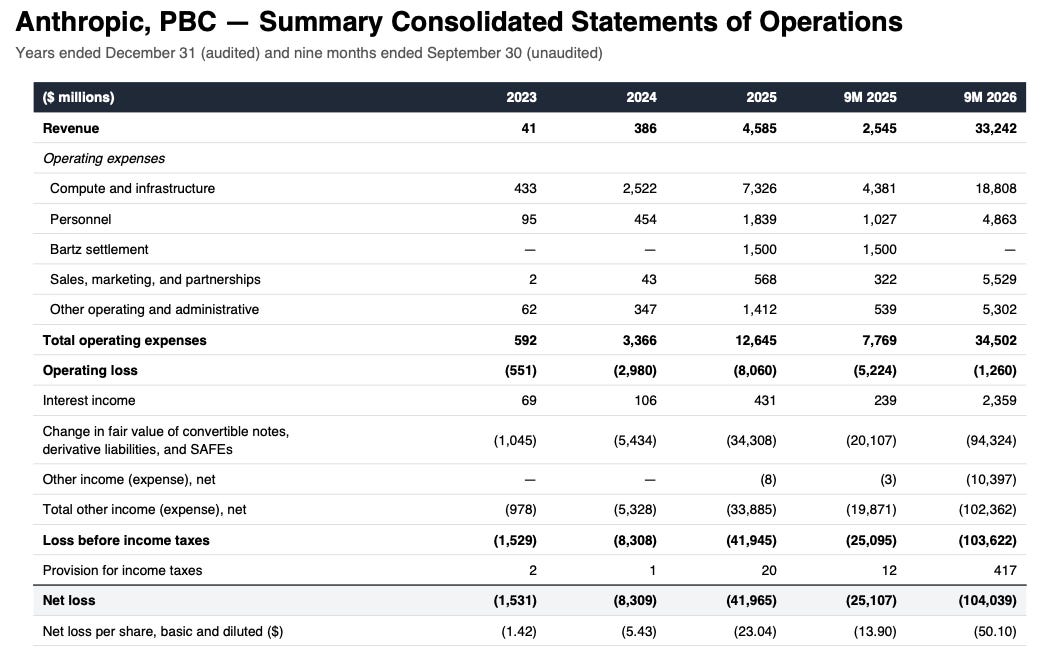
How about revenue streams? Subscription revenue was $98M (25% of total revenue) in 2024, $789M (17%) in 2025, and $6.9B (21%) for nine months of 2026. In other words, while revenue is growing, recurring revenue is less than 25% of their total revenue. Non-recurring “consumption” revenue accounts for the remainder. This should be seen as a concern, particularly for those looking to “trade” rather than invest in Anthropic.
Also, given Anthropic’s lack of government and DoD business, it relies on revenue from a smaller section of the total AI market, namely, AWS, Google Cloud and Azure, amongst others. The company needs to widen its revenue base, particularly with recurring users.
Cash on hand? Anthropic raised $141.1B in total, and held $95.6B in cash and equivalents plus $36.3B in short-term investments (totaling $131.8B).
Wait! If Anthropic has more cash on hand ($132B as of 30 Sept) than companies such as Amazon ($114B), Nvidia ($99B) or Apple ($62B), why in the world is it going public? That doesn’t make sense. Unless early investors are looking for their payday.
Anthropic’s business is strong, especially compared to other IPOs. The real issue is valuation. Is it worth $1.4 trillion?
Market Size, Competition & Regulation
Market
Goldman Sachs projects revenue of about $52B in 2026, $136B in 2027, $442B in 2029 and roughly $685B in 2030. That equates to about 150 times 2025’s $4.585B in revenue. If accurate, or even close to accurate, the projections should dispel concerns over recurring revenue sources, mentioned above.2
In fact, Goldman projects enterprise customers to account for about $590B of the 2030 projection. The remainder from non-enterprise customers (e.g., retail users.) That should cause smart investors to stop and consider.
Most users enjoy using AI chatbots, including Anthropic’s Claude, to assist with tasks, conduct research and frankly, to simplify internet searches. The “compute” demands are lower. Now, imagine when the average “non-enterprise” begins to incorporate agentic AI: from scheduling and managing tasks, bookkeeping, coding, content creation, etc., etc. to coordinating healthcare, travel, finances, etc. And we are only speaking of the non-enterprise user.
What about corporate users? Manufacturing? Robotics? Healthcare? Compute demands are expected to skyrocket.
Artemis assumes Anthropic will capture about 50% of the $800B-$1T enterprise token-spending market by 2030, with Open AI capturing about 30%, and other open-source firms under 10%. Regardless of Jon Ma’s $800B revenue projection from enterprise usage by 2030, the general view is that Anthropic will lead the way.
Competition
So, how do competitors stack up? This is less a question of “Who?” and more about “What?”. Anthropic and Open AI have traded leads in terms of pure usage rates. Conventional wisdom suggests that “Frontier Leads” don’t last, although this is not always easy to verify, as markets and products evolve over time.
However, like most frontier AI companies, Anthropic is in a tangled mess of “partnerships”, many of whom pose a competitive danger. Parrtners who are rivals, usually don’t remain partners. They either beat you or buy you (or beat you, then buy you). Amazon, Google and Microsoft are investors, customers, distributors, compute suppliers and competitors. It’s crazy! And it signals big red flags should Anthropic fail to expand its core business beyond the cozy confines of other AI and tech companies.
Then there is pressure from “open-weight” models. One analyst estimates that open-weight models are now roughly four months behind the frontier at about one-tenth the price.3 At this point, let’s bring China and their models into the equation.
China and its AI companies need two primary tools to both catch-up and compete with frontier AI firms in the US: advanced chips and distillation (i.e., learning from other AI models, such as Anthropic’s Claude and alike).
First, chips. Ironically, Nvidia’s recent “difficulties” could actually be a positive for Anthropic and other US-based frontier AI companies. The Nvidia fallout could actually speed up export restrictions on advanced chip technology to China, and at a critical juncture in the AI infrastructure build out. With advanced chips, the ability to continue rapidly advance existing models becomes weakened.
But what about “distillation?” In February, Anthropic said Chinese models DeepSeek, Moonshot and MiniMax generated over 16 million exchanges with Claude through about 24,000 fraudulent accounts, in violation of its terms and regional restrictions. They allegedly used commercial proxy services to get around the restrictions. In other words, Chinese AI models are learning on the back of US based LLMs, including Anthropic’s—which hardly gives them a proprietary edge.
In response, Anthropic has tightened access restrictions. Anthropic says new safeguards cut distillation attempts by 90% to 99%.
While competition, including competition from China, will not disappear, it will likely fall into categories of competitiveness. Over time, firms will gravitate towards niches as demand for AI evolves. No one should buy Anthropic blindly—it can’t be the leader in every AI category and risk diluting its strengths.
Regulation
While I grimace at the thought of over-regulation, any upcoming regulatory moves by Congress on the AI industry will likely favor the hyper-scalers, including Anthropic, while limiting smaller players—i.e., “regulatory capture.” Essentially, that results in greater controls over non-US AI models, creating a proxy”winner” for companies like Anthropic.
However, regulators have a habit of over-reaching. And, this is an existential threat, particularly to Anthropic, whose CEO has practically begged to be regulated. It is still too early to determine what Congress may do, which, in itself, should be a concern.
For or Against?
Smart investors should ask a few questions of this IPO:
“If not now, when?” While there is plenty of good reasons for long-term investors to buy Anthropic, why now? Given current market volatility, election backlash and uncertainty over regulatory changes, it seems likely opportunities may arise down the road to invest—after the hype has been discounted.
“Who are the buyers?” Some have observed that Anthropic has been “over-shopped.” Traders are chomping at the bit. If this becomes an IPO for traders, again, there is likely opportunity, post-lock-up, to take advantage of discounted prices.
“Why is Anthropic going public now?” With so much cash on the books, a nervous market and other pressures, why not wait?
There are many good reasons to buy Anthropic, but, in my opinion, only if one is holding for the long-term. The AI industry and markets, in general, need for Anthropic to have a successful IPO. It will certainly set the tone for quarters to come (and perhaps confirm or quell the bubblers).
This publication is for brains, not bets. The Other Side of Obvious shares ideas, stories, and general financial information - not personalized investment, tax, or legal advice. Investing comes with risk (including losing money). Talk to a pro before you act. Please take time to read these important disclosures before you get started.
Source: Anthropic, PBC Form S-1/A, Amendment No. 2, filed November 10, 2026 (SEC Registration No. 333-299633), Summary Consolidated Financial and Other Data. Nine-month figures are unaudited. The 9M 2026 net loss includes a $94.3 billion non-cash change in fair value of convertible notes, derivative liabilities, and SAFEs, driven by the increase in enterprise valuation. Personnel expense includes stock-based compensation of $29M, $192M and $1.2B (2023-2025) and $591M and $3.3B (9M 2025 and 9M 2026).
Goldman Sachs is the lead banker in the Anthropic IPO,
Anthropic is somewhat protected because it sells a “harness” (products like Claude Code), not just a model.
Enjoyed the read slowly ….